CCJ Guide
The Complete Guide to Personal Guarantees in the UK
Download our FREE 2026 Edition: The Complete Guide to Personal Guarantees

Clarity.
Time.
Choice.
Control.
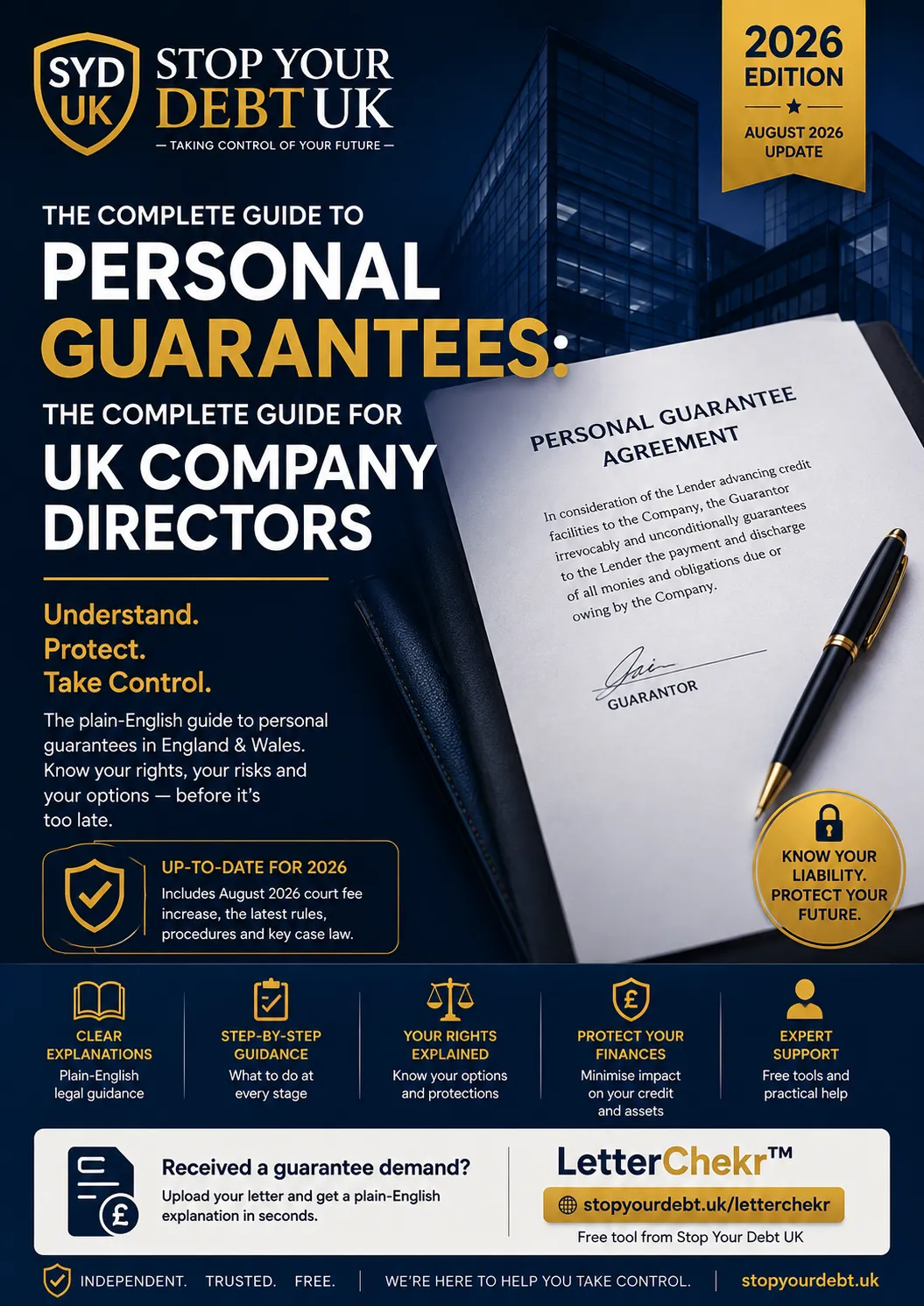
What is included in the Complete Guide to Personal Guarantees?
You'll discover how personal guarantees work, capped vs unlimited liability, secured vs unsecured guarantees, joint and several liability, guarantees vs indemnities, company insolvency, PG enforcement, CCJs, charging orders, property exposure, bankruptcy, potential challenges, limitation issues, creditor negotiation, Bounce Back Loans, director duties and the practical steps to take after receiving a demand...and more.
Personal Guarantees: The Complete Guide for UK Company Directors
Signed a personal guarantee for business borrowing? Worried about what happens if your company cannot repay its debts? Download our comprehensive 2026 Personal Guarantees Guide for UK company directors and understand your position before deciding what to do next.
Running a limited company normally creates an important separation between the finances of the business and those of its directors. However, a personal guarantee (PG) can change that position significantly.
Directors are frequently asked to sign personal guarantees when obtaining business loans, asset finance, commercial leases, supplier credit and other forms of funding. While the company is trading successfully, the guarantee may receive little attention. It is often only when cash flow deteriorates, the business becomes insolvent or a lender issues a demand that the director discovers just how important the wording of that document can be.
That is why Stop Your Debt UK has created Personal Guarantees: The Complete Guide for UK Company Directors — 2026 Edition.
This detailed guide explains how personal guarantees work, when they may become enforceable, what creditors can do, how company insolvency affects a guarantee, what can potentially be challenged, and the options directors may have when a lender demands payment.
It is designed to help you understand the problem before you react to it.
What is a personal guarantee?
A personal guarantee is essentially a contractual promise by an individual to answer for another party's obligations. In a business context, that commonly means a director agreeing to become personally responsible if their limited company fails to meet an obligation covered by the guarantee.
This distinction matters.
If your limited company owes £80,000 to a lender, that does not automatically mean you personally owe £80,000 simply because you are a director.
But if you signed an enforceable personal guarantee covering that borrowing, the creditor may have a separate route to pursue you personally if the relevant contractual conditions are satisfied.
Our guide explains this crucial difference using plain-English examples and diagrams, including the basic journey:
Company borrowing → Personal guarantee → Company default → Potential personal liability
Understanding that relationship is the starting point for dealing with a PG properly.
What types of business debt can have personal guarantees?
Personal guarantees appear across many forms of commercial finance.
A director may encounter a PG in connection with a business loan, commercial property lease, asset finance agreement, invoice finance facility, supplier account, overdraft or other commercial funding arrangement.
The important question is not simply:
“Did my company borrow money?”
It is:
“Exactly what did I personally agree to guarantee?”
Our Personal Guarantees Guide explains the difference between capped and unlimited guarantees, secured and unsecured exposure, continuing guarantees and situations involving more than one guarantor.
It also examines joint and several liability, an area that can surprise directors. Where the documentation creates joint and several liability, a creditor may not necessarily be required to divide its claim equally between several guarantors.
The wording of the actual agreement matters.
Does liquidation cancel a personal guarantee?
This is one of the most important questions directors ask when their company is approaching insolvency.
In general, putting a limited company into liquidation does not automatically cancel a director's personal guarantee.
The company and the individual guarantor are legally distinct.
That means a director considering a Creditors' Voluntary Liquidation (CVL), administration or another insolvency process should identify any personal guarantees before deciding how to proceed.
The guide explains the relationship between:
Company insolvency → creditor loss/default → PG demand → potential personal enforcement
It also explains why directors should not make decisions about company creditors solely on the basis of protecting themselves from a personal guarantee.
This has become particularly important following updated 2026 Insolvency Service guidance concerning directors of companies experiencing financial distress.
What happens when a lender calls in a personal guarantee?
Receiving a personal guarantee demand can be intimidating, particularly when the amount demanded runs into tens or hundreds of thousands of pounds.
But receiving a demand does not mean the sensible response is simply to pay immediately or ignore it.
The first step should be understanding exactly what has happened.
Our guide walks directors through the typical personal guarantee enforcement lifecycle, from company default and creditor demand through to potential court proceedings and enforcement.
It explains why you should establish:
what document was actually signed;
who the guarantor is;
which debt or facility is covered;
whether liability is capped;
whether the creditor has complied with relevant contractual requirements;
what amount is actually outstanding;
whether the guarantee contains an indemnity;
and whether there are legitimate grounds requiring further investigation.
A demand should therefore trigger document review, not panic.
Can a personal guarantee be challenged?
A signature on a document does not mean every possible challenge will succeed. Equally, directors should not assume that every guarantee is automatically beyond examination.
The circumstances and documentation matter.
Our guide explains some of the issues that may warrant closer legal examination, including execution, contractual wording, variations to the underlying facility, scope of liability, misrepresentation, undue influence and other potential defences depending on the circumstances.
It also explains an important distinction frequently overlooked online: a guarantee and an indemnity are not necessarily the same thing.
Some commercial documents contain both.
This is precisely why directors facing substantial PG exposure should have the actual documentation reviewed rather than relying on generic advice found online.
The guide does not promise that a guarantee can simply be “written off”. Instead, it helps you understand the questions that should be asked.
Can a personal guarantee be negotiated?
Not every personal guarantee dispute needs to end in lengthy court proceedings.
Depending on the facts, creditor, documentation and financial circumstances, there may be scope for commercial negotiation, repayment arrangements, settlement discussions or other resolutions.
A creditor will usually consider the commercial reality of recovery.
That can include the amount outstanding, the guarantor's financial circumstances, available assets, litigation costs, timescale, competing liabilities and the likelihood of successful recovery.
The guide explains how PG negotiations can work and why a properly prepared financial position can be considerably more useful than simply telling a creditor that you cannot afford to pay.
There are no guaranteed settlement percentages. Every case needs to be considered individually.
Can a creditor get a CCJ for a personal guarantee?
Potentially, yes.
If a creditor brings a successful court claim based upon a personal guarantee, the result may be a County Court Judgment (CCJ) against the guarantor.
That can potentially lead to enforcement action.
Our guide therefore explains the journey from:
PG demand → court claim → judgment → enforcement
It covers the potential significance of enforcement agents, charging orders and other enforcement mechanisms, as well as why court documents should never simply be ignored.
This is especially important for directors who own a home.
Can a personal guarantee put your home at risk?
A personal guarantee does not automatically give a creditor ownership of your house.
However, if a creditor establishes a personal debt and obtains the necessary court orders, property can become relevant to enforcement.
The guide explains charging orders and property exposure in straightforward language, without using scare tactics.
For directors with substantial equity in their home or other personal assets, understanding the enforcement pathway early can be extremely important.
The key message is simple:
Do not wait until enforcement has reached an advanced stage before reviewing your options.
Can a personal guarantee lead to bankruptcy?
A sufficiently large unpaid personal guarantee debt can potentially form part of a bankruptcy route where the legal requirements are satisfied.
Our guide explains the relationship between statutory demands, bankruptcy petitions and personal guarantee liabilities, including the important distinction between company insolvency and the personal insolvency of a director.
Bankruptcy is not the automatic consequence of receiving a PG demand. There are procedural stages and legal requirements before someone can be made bankrupt.
Understanding those stages gives directors a much clearer picture of their actual position.
What about Bounce Back Loans?
There is considerable confusion surrounding Bounce Back Loans and personal guarantees.
The guide includes a dedicated explanation because a Bounce Back Loan should not simply be treated as equivalent to ordinary commercial borrowing backed by a director's PG.
It also explains another critical distinction: the absence of a personal guarantee does not provide protection against consequences arising from misconduct.
Company debt, contractual personal liability and potential director liability arising from conduct are different legal concepts.
Keeping those issues separate is essential when considering an insolvent company with an outstanding Bounce Back Loan.
Directors of insolvent companies need to be particularly careful
The Personal Guarantees Guide also goes beyond the PG document itself.
Where a company is insolvent or approaching insolvency, directors need to consider their wider duties.
One particularly important issue is the temptation to repay the lender whose debt carries a personal guarantee while leaving other company creditors unpaid.
That can create additional insolvency-law considerations.
The guide therefore explains why directors should consider the interests of creditors and obtain appropriate professional advice rather than making payments purely to reduce their own personal PG exposure.
This is an area where business debt, insolvency law and personal guarantees intersect, and it is one of the reasons we created such a detailed guide.
Already received a personal guarantee demand?
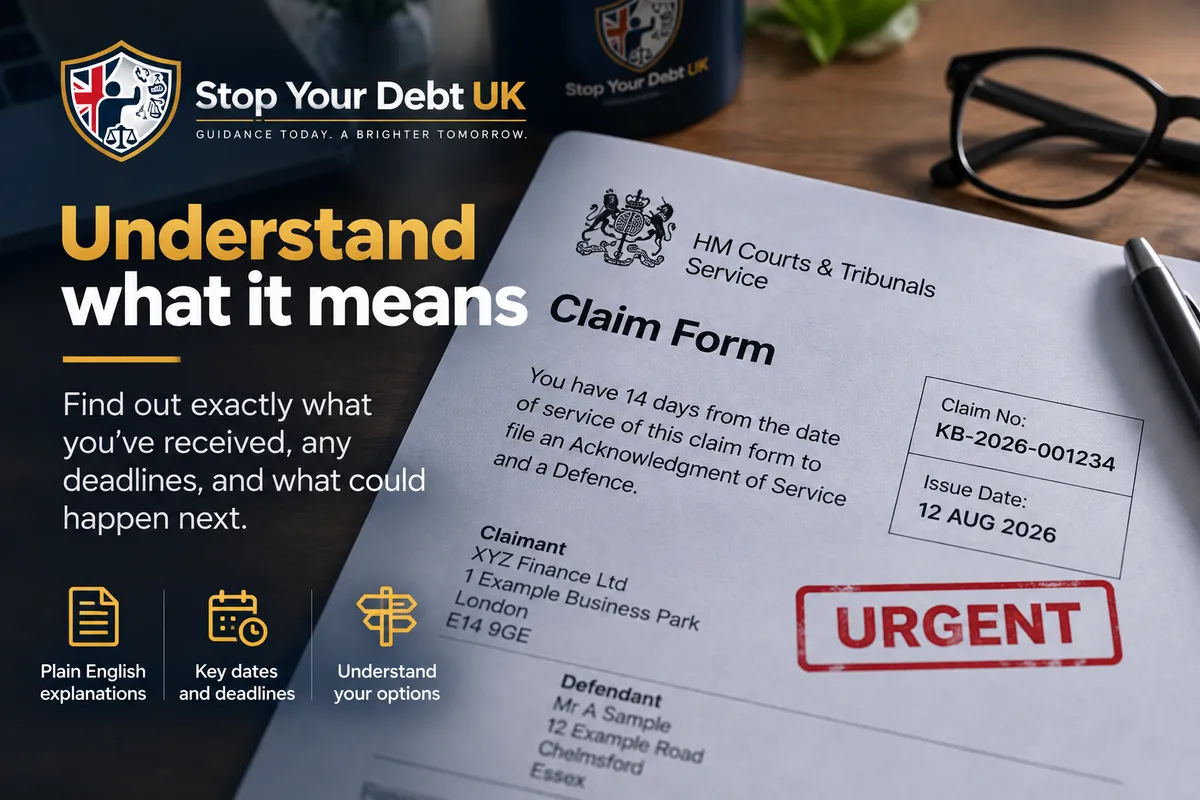
If a lender, solicitor or debt recovery company has contacted you, the first challenge is often simply understanding the letter.
Stop Your Debt UK's LetterChekr™ service is designed to help with exactly that.
Upload your creditor or debt letter to LetterChekr™ to help understand what it says in plain English, identify important information and establish what may require your attention.
Our Personal Guarantees: The Complete Guide for UK Company Directors — 2026 Edition goes considerably deeper than this overview.
Inside, you'll discover how personal guarantees work, capped vs unlimited liability, secured vs unsecured guarantees, joint and several liability, guarantees vs indemnities, company insolvency, PG enforcement, CCJs, charging orders, property exposure, bankruptcy, potential challenges, limitation issues, creditor negotiation, Bounce Back Loans, director duties and the practical steps to take after receiving a demand.
Most importantly, the guide is designed to replace uncertainty with clarity.
If your business is struggling, you have already entered liquidation, or a creditor is threatening to enforce a personal guarantee, understanding your legal and financial position early can give you more time to make informed decisions.
Know what you signed. Understand what the creditor can do. Identify your options before deciding what happens next.
Download the free 2026 Personal Guarantees Guide from Stop Your Debt UK and understand where you stand.
This guide provides general information for directors in England and Wales and is not a substitute for advice on your individual circumstances. Personal guarantee enforceability is highly dependent on the underlying documents and facts of each case.
What Does This Letter Actually Mean?
Try LetterChekr™
Three Simple Steps
1. Upload Your Letter
Take a clear photograph of the letter or upload your document.
You don't need to understand what it says before uploading it.
2. Understand What It Means
LetterChekr™ reviews the contents and explains the important information in plain, straightforward English.
3. Understand What May Happen Next
You'll receive clear information about the urgency of the correspondence, important dates, potential consequences and the general processes that may follow.
LetterChekr™
Book a Call With a Consultant
Complete your details below and one of our consultants can discuss the letter with you and help you understand the options available.
That's it. In around 30 seconds, you'll receive a plain-English explanation of your letter.
Stop Your Debt UK is a national debt support platform helping individuals and company directors understand financial problems, organise their position and access the appropriate professional support when specialist or regulated advice is required.
Quick links
Services
Stop Your Debt UK is not an FCA-authorised debt advice firm or an SRA-regulated law firm. Where regulated or reserved professional services are required, the relevant work is undertaken by an appropriately authorised third-party professional. Learn More
© Stop Your Debt UK. 2026. All Rights Reserved.