
CCJ Guide
The Complete Guide to County Court Judgments (CCJs) in the UK
Download our FREE 2026 Edition: The Complete Guide to CCJs

Clarity.
Time.
Choice.
Control.
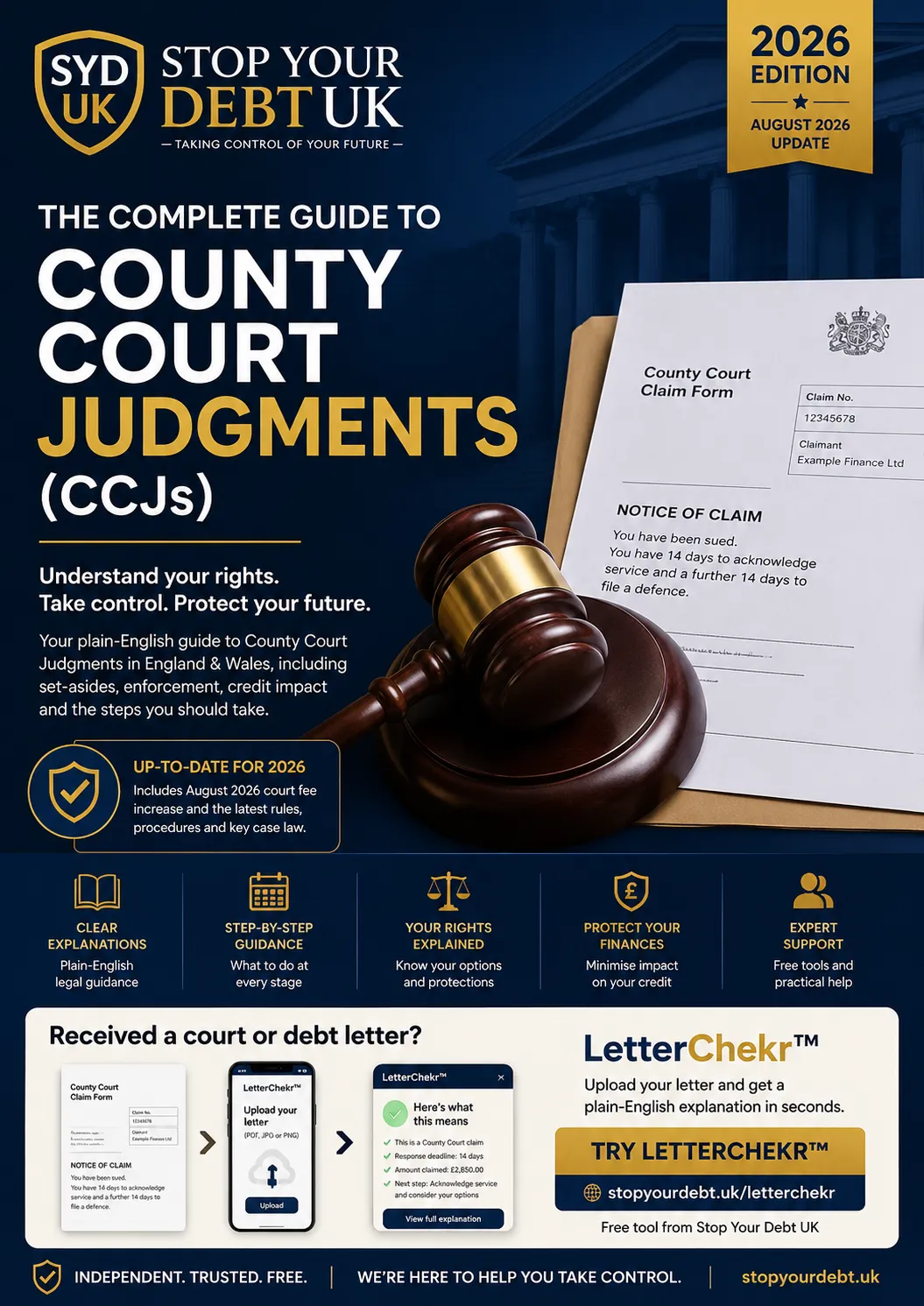
What is included in the Complete Guide to CCJs?
We created the guide for someone who wants to go beyond a short internet article and understand the whole CCJ journey.
It takes you from the period before proceedings all the way through to judgment and potential enforcement.
County Court Judgments (CCJs) Explained: What They Are, How They Happen and What You Can Do
Receiving court paperwork or discovering a County Court Judgment (CCJ) on your credit file can be alarming. You may immediately wonder whether bailiffs are coming, whether your home is at risk, whether you can still obtain credit, or whether there is any way to have the judgment removed.
The important thing is to understand exactly where you are in the process.
A debt, a Letter of Claim, a County Court claim and a County Court Judgment are not the same thing. And even after a CCJ has been entered, what happens next depends on the circumstances.
That is why we created The Complete Guide to County Court Judgments (CCJs) – 2026 Edition from Stop Your Debt UK.
The downloadable guide takes you through the CCJ process in plain English, including court claims, payment, setting aside a default judgment, enforcement, bailiffs, charging orders and the practical steps you can consider at each stage.
This article gives you an overview of the most important areas covered in the guide.
What is a CCJ?
A County Court Judgment, commonly called a CCJ, is a judgment made through the County Court in England and Wales.
In the context of a debt claim, it means the court has formally determined that money is payable. The judgment should explain how much is owed, how it should be paid, the deadline for payment and who should receive it.
One important misconception is that receiving a threatening letter from a creditor means you already have a CCJ.
It doesn't.
There may be several stages before judgment, potentially including creditor correspondence, a Letter of Claim and formal court proceedings.
This distinction matters because your options can change significantly depending on which stage you have reached.
Received a letter and don't know what it means?
You can also use LetterChekr™ to help understand debt and court correspondence in plain English.
How do CCJs happen?
A CCJ can arise when someone claims that you owe them money and takes court action.
That might involve a credit agreement, loan, unpaid invoice, contractual dispute, parking claim or another civil debt.
Before proceedings, there may be pre-action correspondence. If a formal claim is subsequently issued, it is important not to ignore it.
The claim paperwork will tell you what is being claimed and how you can respond.
Depending on the circumstances, you might accept the claim, accept only part of it, or dispute it.
A particularly important risk arises when court proceedings are simply ignored. Where the requirements of the Civil Procedure Rules are satisfied, a claimant may be able to obtain default judgment because the defendant has not provided the required response.
This is one reason opening and understanding court correspondence quickly is so important.
How long does a CCJ last?
This is one of the most frequently misunderstood areas.
A CCJ will generally remain on the Register of Judgments, Orders and Fines for six years, unless it is removed earlier in circumstances where the rules allow it. Banks and lenders can use this information when assessing applications for credit.
But there is an important distinction between:
the judgment itself and how long it appears on the register or credit record.
The fact that the six-year registration period has ended does not simply mean that the judgment debt has automatically been written off.
Our complete guide explains this distinction in more detail because misunderstanding the “six-year rule” can lead people to make poor decisions about an existing judgment.
Paying a CCJ within 30 days – or, more accurately, one calendar month
You will often hear people say:
“Pay a CCJ within 30 days and it disappears.”
The official rule is actually one month, rather than a universal “30-day” period.
If the judgment is paid in full within one month, you can have the judgment removed from the Register. You will need to tell the court and provide the required evidence of payment.
This can make acting quickly after judgment particularly important.
If you pay the judgment after one month, the situation is different. The judgment will generally remain registered for the six-year period, but it can be marked satisfied, showing that it has been paid.
So there is a substantial difference between:
paid within one month → potential cancellation/removal from the Register
and
paid after one month → normally remains registered but can be marked satisfied.
The full guide explains the process and the relevant certificate of cancellation or satisfaction.
Can you set aside a CCJ?
Potentially.
But a CCJ cannot simply be removed because somebody does not want it appearing on their credit file.
A set aside is a court process.
For default judgments, CPR Part 13 contains two particularly important routes.
Under CPR 13.2, the court must set aside a default judgment where the specified conditions showing that it was wrongly entered are met.
Under CPR 13.3, the court may set aside or vary a default judgment where the defendant has a real prospect of successfully defending the claim or there is some other good reason why the judgment should be set aside or varied, or why the defendant should be allowed to defend the claim. The court must also consider whether the application was made promptly.
This is why discovering a CCJ at an old address deserves proper investigation rather than relying on statements such as:
“It went to my old address, so the court has to remove it.”
That is too simplistic.
Service of the original claim, what the claimant knew about your address, the circumstances in which judgment was obtained and whether there is a genuine defence can all be important.
An application to set aside a default judgment will commonly involve Form N244, and GOV.UK currently states that a £321 court fee may apply.
The guide contains a dedicated CCJ set-aside decision tree explaining this much more clearly.
CCJ removal – when can a judgment actually disappear?
There is an important difference between removal, satisfaction and set aside.
These terms are sometimes incorrectly used interchangeably online.
A judgment paid in full within one month can potentially be removed from the Register through the cancellation process.
A judgment paid after one month can generally be marked satisfied, but ordinarily remains registered for the balance of the six-year period.
A judgment that is set aside, meanwhile, has been undone by an order of the court.
But even this does not necessarily mean the underlying debt has disappeared.
For example, if a default judgment is set aside, the defendant may subsequently need to defend the original claim. The claimant may still attempt to establish that the money is owed.
That distinction is important:
Setting aside the judgment does not automatically write off the underlying debt.
What happens if a CCJ isn't paid?
A CCJ and enforcement are separate stages.
The existence of a judgment does not mean bailiffs automatically arrive at your home the following day.
However, if a judgment is not paid in accordance with the court order, the judgment creditor may consider enforcement.
Depending on the circumstances, enforcement mechanisms can include a warrant or writ of control, attachment of earnings, third-party debt order or charging order.
The appropriate method depends on the particular case.
This is another major section of our downloadable guide because understanding the specific enforcement action being threatened is much more useful than simply thinking:
“I have a CCJ, therefore bailiffs are coming.”
Can bailiffs come because of a CCJ?
They potentially can, but there is a process.
A creditor can ask the court to enforce an unpaid judgment through a warrant of control in appropriate circumstances.
An enforcement agent can then seek payment and, where the legal requirements are met, take control of goods.
GOV.UK's CCJ guidance explains that a creditor needs to apply to the court for a warrant before bailiffs can be used to collect the judgment debt.
The rules around enforcement agents are more detailed than the popular image of someone simply arriving and taking whatever they want.
If you receive an enforcement notice, the best approach is not to hide the letter or assume the worst. Identify:
who is enforcing the debt, what judgment they are enforcing, how much is claimed, what stage enforcement has reached and what deadline applies.
The guide explains the enforcement lifecycle visually so you can see where bailiffs fit into the wider CCJ process.
What is a charging order?
For homeowners, the words charging order can understandably cause considerable concern.
A charging order is an enforcement mechanism that can secure a judgment against the debtor's interest in an asset such as land or property. CPR Part 73 governs charging orders, stop orders and stop notices.
However, a charging order should not automatically be interpreted as:
“The creditor is taking my house.”
A charging order and an order for sale are different legal steps.
GOV.UK explains that a creditor can apply to have a charge placed on a debtor's land or property, with the charge then relevant when that property is sold.
Property ownership, equity, existing mortgages and charges, the circumstances of the judgment and any subsequent application can therefore matter.
Our guide includes a dedicated section explaining CCJs, charging orders and property exposure without using the scare tactics sometimes found in debt-related marketing.
What is included in the Complete Guide to CCJs?
We created the guide for someone who wants to go beyond a short internet article and understand the whole CCJ journey.
It takes you from the period before proceedings all the way through to judgment and potential enforcement.
Inside you'll learn about Letters of Claim, County Court claims, response deadlines, default judgments, mediation, paying a judgment, the one-month rule, the six-year Register period, N244 applications, mandatory and discretionary set-aside grounds, old-address judgments, limitation issues, default notices, N245 applications, affordability, Breathing Space, bailiffs, charging orders and other enforcement methods.
We've also included practical visuals and decision trees so you don't have to interpret pages of legal terminology.
One of the most useful sections is our “Three Questions to Ask About Any CCJ” framework:
Do you dispute the debt or judgment?
Do you accept the debt but cannot afford the payment?
Or did you only discover the CCJ after judgment had already been entered?
Those can lead to very different conversations.
And that is really the philosophy behind the entire Stop Your Debt UK CCJ guide.
A CCJ should not be ignored, but neither should you automatically assume the worst.
Understand the document. Understand the stage. Understand the deadline. Then understand your options.
Download The Complete Guide to County Court Judgments (CCJs) – 2026 Edition
Our full downloadable guide gives you the diagrams, timelines, checklists and explanations that we cannot realistically fit into a single article.
The Complete Guide to County Court Judgments (CCJs)
2026 Edition | Stop Your Debt UK
It covers the journey from the first warning signs through to court proceedings, judgment, possible set aside and enforcement — helping you know exactly where you stand before deciding what to do next.
What Does This Letter Actually Mean?
Try LetterChekr™
Three Simple Steps
1. Upload Your Letter
Take a clear photograph of the letter or upload your document.
You don't need to understand what it says before uploading it.
2. Understand What It Means
LetterChekr™ reviews the contents and explains the important information in plain, straightforward English.
3. Understand What May Happen Next
You'll receive clear information about the urgency of the correspondence, important dates, potential consequences and the general processes that may follow.
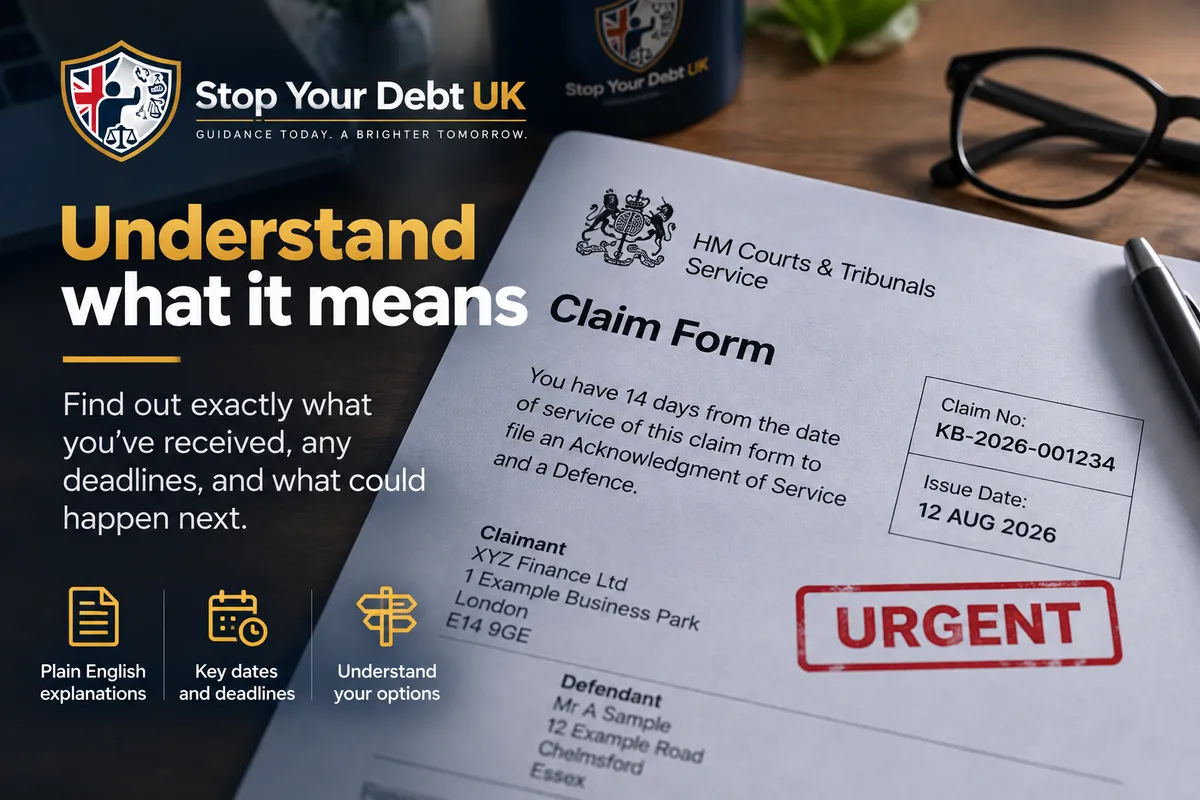
LetterChekr™
Book a Call With a Consultant
Complete your details below and one of our consultants can discuss the letter with you and help you understand the options available.
That's it. In around 30 seconds, you'll receive a plain-English explanation of your letter.
Stop Your Debt UK is a national debt support platform helping individuals and company directors understand financial problems, organise their position and access the appropriate professional support when specialist or regulated advice is required.
Quick links
Services
Stop Your Debt UK is not an FCA-authorised debt advice firm or an SRA-regulated law firm. Where regulated or reserved professional services are required, the relevant work is undertaken by an appropriately authorised third-party professional. Learn More
© Stop Your Debt UK. 2026. All Rights Reserved.