Business Insolvency Guide
The Complete Guide to Business Debt And Insolvency in the UK
Download our FREE 2026 Edition: The Complete Guide to Business Debt And Insolvency

Clarity.
Time.
Choice.
Control.
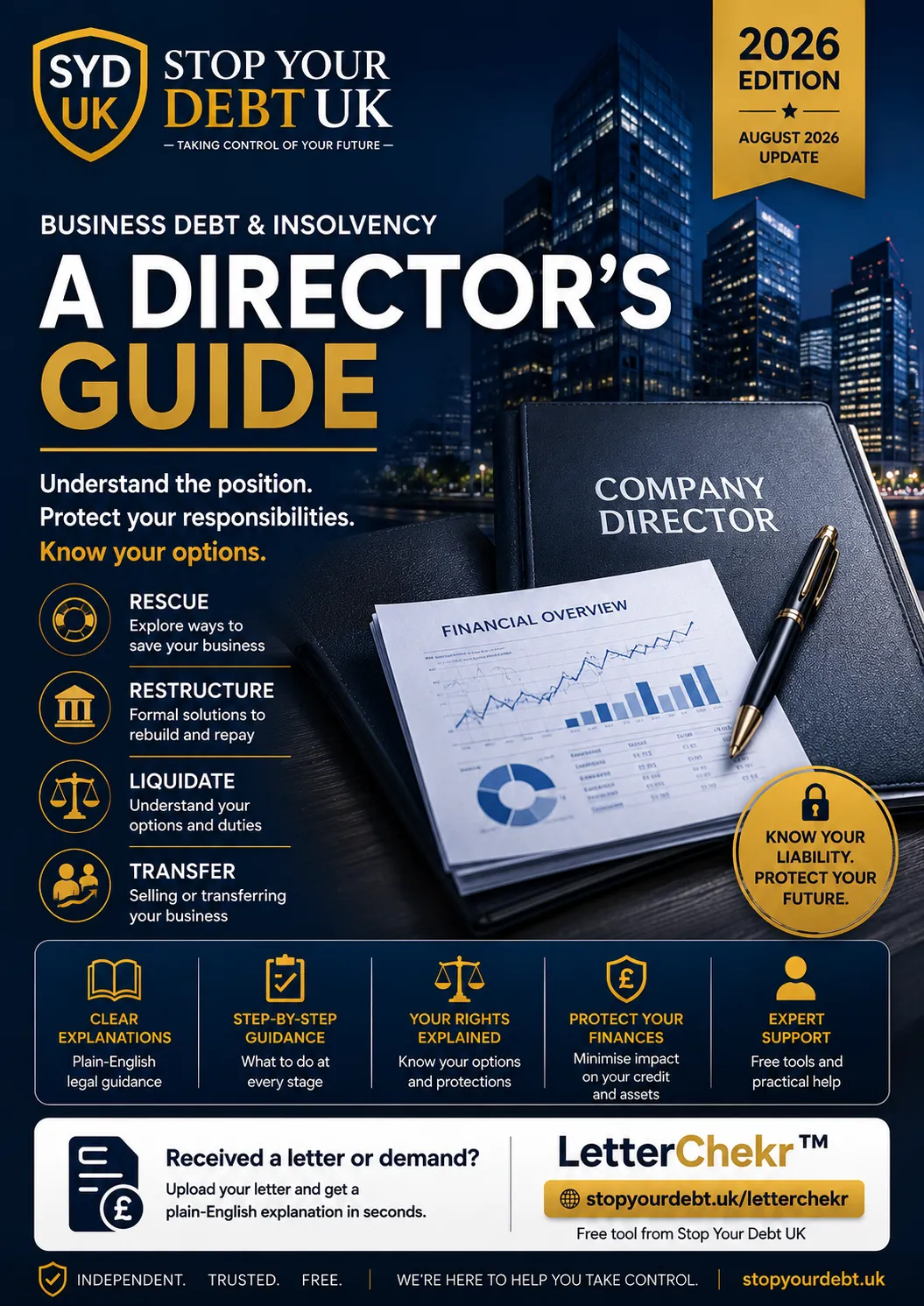
What is included in the Complete Guide to Business Debt And Insolvency?
You'll discover how personal guarantees work, capped vs unlimited liability, secured vs unsecured guarantees, joint and several liability, guarantees vs indemnities, company insolvency, PG enforcement, CCJs, charging orders, property exposure, bankruptcy, potential challenges, limitation issues, creditor negotiation, Bounce Back Loans, director duties and the practical steps to take after receiving a demand...and more.
Business Debt & Insolvency: A Director’s Guide – Understand Your Options Before the Situation Escalates
Running a limited company comes with responsibility. When a business begins struggling with HMRC arrears, unpaid suppliers, business loans, Bounce Back Loans, personal guarantees, cash-flow problems or increasing creditor pressure, those responsibilities can suddenly become much harder to understand.
For many company directors, the biggest problem is not simply the amount of debt.
It is not knowing what happens next.
Can the business continue trading? Are you personally responsible for company debts? Can HMRC wind up the company? What happens if you have signed a personal guarantee? Could a Company Voluntary Arrangement (CVA) rescue the business? When should a director consider a Creditors’ Voluntary Liquidation (CVL)? What happens if a creditor has already threatened a winding-up petition? And are there circumstances where a company can legitimately be sold or transferred instead?
These are precisely the questions addressed in the Stop Your Debt UK Business Debt & Insolvency: A Director’s Guide – 2026 Edition.
The guide has been created to give UK company directors a clear, plain-English introduction to business debt, company insolvency, director responsibilities and the principal options available when a limited company is experiencing serious financial difficulty.
Its central message is simple:
Understand the position. Protect your responsibilities. Know your options.
When Does Business Debt Become a Serious Problem?
Having debt does not automatically mean that a company is insolvent.
Most businesses use some form of credit. A company may owe money to suppliers, HMRC, landlords, banks, finance companies and other commercial creditors while continuing to trade perfectly normally.
The position becomes more concerning when the company can no longer meet its liabilities as they fall due.
Warning signs can include:
VAT, PAYE or Corporation Tax arrears continuing to increase
suppliers reducing or withdrawing credit terms
failed Direct Debits and bounced payments
constantly deciding which creditor to pay first
difficulty meeting payroll
an overdraft permanently at its limit
taking new borrowing simply to service existing borrowing
County Court Judgments or formal demands
escalating creditor or HMRC enforcement
no reliable understanding of the company's cash position
One of the first areas explained in our guide is therefore how company insolvency is assessed.
Directors need to understand both cash-flow insolvency and the broader balance-sheet assessment, as well as the circumstances described under section 123 of the Insolvency Act 1986.
Recognising financial distress early matters because a company may have considerably more options before creditor action reaches an advanced stage.
Does a Director Personally Owe the Company's Debts?
This is one of the most important questions we encounter.
A limited company has a separate legal identity from its directors and shareholders. Therefore, a debt properly incurred by the company is normally owed by the company rather than automatically by its director.
That distinction is fundamental.
However, limited liability should never be interpreted as meaning that directors can never face personal exposure.
Our Business Debt & Insolvency Guide explains some of the major areas that need to be considered separately, including:
Personal guarantees – where a director has contractually guaranteed a company's borrowing or another obligation.
Director's loan accounts – particularly where the director has an overdrawn DLA and therefore potentially owes money back to the company.
Personal security – where personal assets have been used as security.
Misfeasance or breach of duty – where company money or property has been improperly dealt with.
Transactions at an undervalue and preferences – transactions entered into before insolvency can potentially be examined by a subsequently appointed office-holder.
Wrongful or fraudulent trading – serious concepts that are frequently misunderstood online and should not simply be equated with a company experiencing financial difficulty.
The guide explains an important distinction:
Business failure is not automatically director misconduct.
Companies can and do fail for entirely legitimate commercial reasons. The critical issue is how directors behave as the financial position deteriorates.
Director Duties When a Company Is Approaching Insolvency
When insolvency threatens, directors should become increasingly careful about the decisions they make.
This is not the time to hide problems, destroy records, transfer assets for nominal values or selectively move company money without understanding the consequences.
Instead, directors should establish the company's true financial position, preserve proper records, document important decisions and obtain appropriate professional advice where necessary.
Our guide covers transactions that may attract particular scrutiny, including:
connected-party transactions
asset transfers
repayment of certain creditors
director withdrawals
dividends
unusual payments
transactions at an undervalue
preferences
A useful question for a director facing insolvency is:
Would I be comfortable explaining this transaction, why it was undertaken, what evidence supported it and who benefited from it to an independent insolvency practitioner later?
That simple question can change the way difficult decisions are approached.
HMRC Debt, Statutory Demands and Winding-Up Petitions
HMRC debt is one of the most common problems facing financially distressed UK businesses.
VAT, PAYE, National Insurance and Corporation Tax arrears can accumulate quickly, particularly when a company starts using money intended for future tax payments to maintain day-to-day trading.
Our guide explains the importance of determining whether the business can genuinely afford both its historic arrears and its future liabilities.
Where appropriate, an HMRC Time to Pay arrangement may form part of the solution. But an arrangement that clears historic tax debt while the company immediately accumulates new arrears is unlikely to solve the underlying problem.
The guide also follows the escalation of creditor action through formal demands, court proceedings and potentially a winding-up petition.
A winding-up petition should never be treated as another ordinary debt collection letter.
Once matters have reached this stage, directors need to act quickly and understand exactly what has been received.
Rescue, Restructure, Liquidate or Transfer?
One of the most important sections of the guide examines the different directions available to a financially distressed business.
There is no single solution suitable for every company.
Broadly, directors may need to consider four categories:
Rescue – which could include creditor negotiation, HMRC arrangements, refinancing or new investment.
Restructure – potentially involving formal procedures such as a CVA, administration, moratorium or, in suitable circumstances, a restructuring plan.
Liquidate – including a Creditors' Voluntary Liquidation or compulsory liquidation.
Transfer or sale – which may include a genuine going-concern sale, asset sale or share acquisition depending on the circumstances.
The correct question is not simply:
"How do I avoid liquidation?"
It is:
"Which lawful route best fits the company's financial position, future viability, creditor circumstances and my responsibilities as a director?"
CVA – Can the Company Be Rescued?
A Company Voluntary Arrangement (CVA) is a formal insolvency procedure that can allow an insolvent company to agree a structured repayment or compromise with creditors while continuing to trade.
The important word is viability.
A CVA is not designed simply to postpone an inevitable business failure. There needs to be a credible underlying business capable of continuing under the proposed arrangement.
The guide explains the CVA lifecycle, the role of the insolvency practitioner, creditor voting and what happens after approval.
It also addresses an important misconception for directors:
A CVA does not automatically release a personal guarantee.
Company debt and the director's contractual liability under a PG need to be considered separately.
CVL – Closing an Insolvent Company Voluntarily
Where the underlying business is no longer viable, directors may instead consider a Creditors' Voluntary Liquidation (CVL).
A CVL is a recognised formal insolvency procedure for bringing the affairs of an insolvent company to an orderly conclusion.
Our guide explains the process from identifying insolvency and obtaining advice through to shareholder decisions, appointment of an authorised insolvency practitioner, creditor claims, asset realisation and eventual dissolution.
It also explains what can happen to:
company assets, cash, outstanding invoices, employees, leases, contracts, personal guarantees, Bounce Back Loans and director loan accounts.
Importantly, entering CVL does not automatically mean that a director has done something wrong or will be disqualified.
Director conduct and the failure of the company are separate questions.
Compulsory Liquidation
The guide also explains what happens when liquidation is no longer being initiated voluntarily.
A creditor may seek to wind up a company through the courts where the necessary legal requirements are satisfied.
If the court ultimately makes a winding-up order, the company enters compulsory liquidation, with the Official Receiver normally becoming liquidator initially.
For a director, the difference between taking early advice and waiting until a creditor controls the timetable can be significant.
That is another reason why creditor correspondence should never simply be ignored.
What About Selling or Transferring an Insolvent Company?
This is an area where directors need particularly careful information.
A genuine distressed-company share acquisition can potentially take place. However, a share purchase is a corporate transaction – it is not itself a statutory insolvency procedure.
If a purchaser acquires the shares in a company, the company itself remains the same legal entity.
If ABC Ltd owed £300,000 before the shares changed ownership, ABC Ltd does not suddenly stop owing that £300,000 simply because its shareholder has changed.
The guide therefore explains both what can change and what does not disappear following a share acquisition.
Personal guarantees do not automatically vanish.
An overdrawn director's loan account does not automatically disappear.
Historic misconduct is not erased.
Creditor rights are not removed.
Investigation powers are not defeated simply because ownership changes.
Any distressed-company acquisition needs genuine due diligence, proper documentation and a legitimate commercial basis.
Personal Guarantees, Bounce Back Loans and Director Loan Accounts
Three subjects deserve particular attention because they can potentially create consequences outside the company's ordinary unsecured liabilities.
The guide therefore includes dedicated explanations of personal guarantees, overdrawn director loan accounts and Bounce Back Loans.
A Bounce Back Loan is generally borrowing by the company, but questions concerning false applications, misuse of funds or other misconduct are separate matters.
Likewise, a PG needs to be examined independently from whatever happens to the company.
This is why directors should never assume:
"The company has gone into liquidation, so my guarantee has disappeared."
It hasn't necessarily.
A Practical Director Action Plan
The final section of the guide turns the information into practical action.
If your company is struggling, start by identifying every creditor, every outstanding liability, every personal guarantee and every important deadline.
Build an accurate short-term cash-flow picture.
Review security.
Understand the director's loan account.
Preserve company records.
Stop questionable transactions.
Identify court claims, statutory demands or winding-up threats requiring urgent attention.
Then assess the available routes objectively:
Rescue. Restructure. Liquidate. Transfer.
The earlier this work is done, the clearer the position becomes.
Download the Business Debt & Insolvency: A Director's Guide
If you are a UK company director facing business debt, HMRC arrears, creditor pressure, cash-flow problems, personal guarantees, Bounce Back Loan concerns or potential company insolvency, this guide has been created to help you understand what happens next.
You do not need more jargon.
You need to know exactly where the company stands, understand where your personal exposure begins and ends, and identify the options available before making important decisions.
Download the free 2026 Business Debt & Insolvency: A Director's Guide from Stop Your Debt UK.
Understand the position. Protect your responsibilities. Know your options.
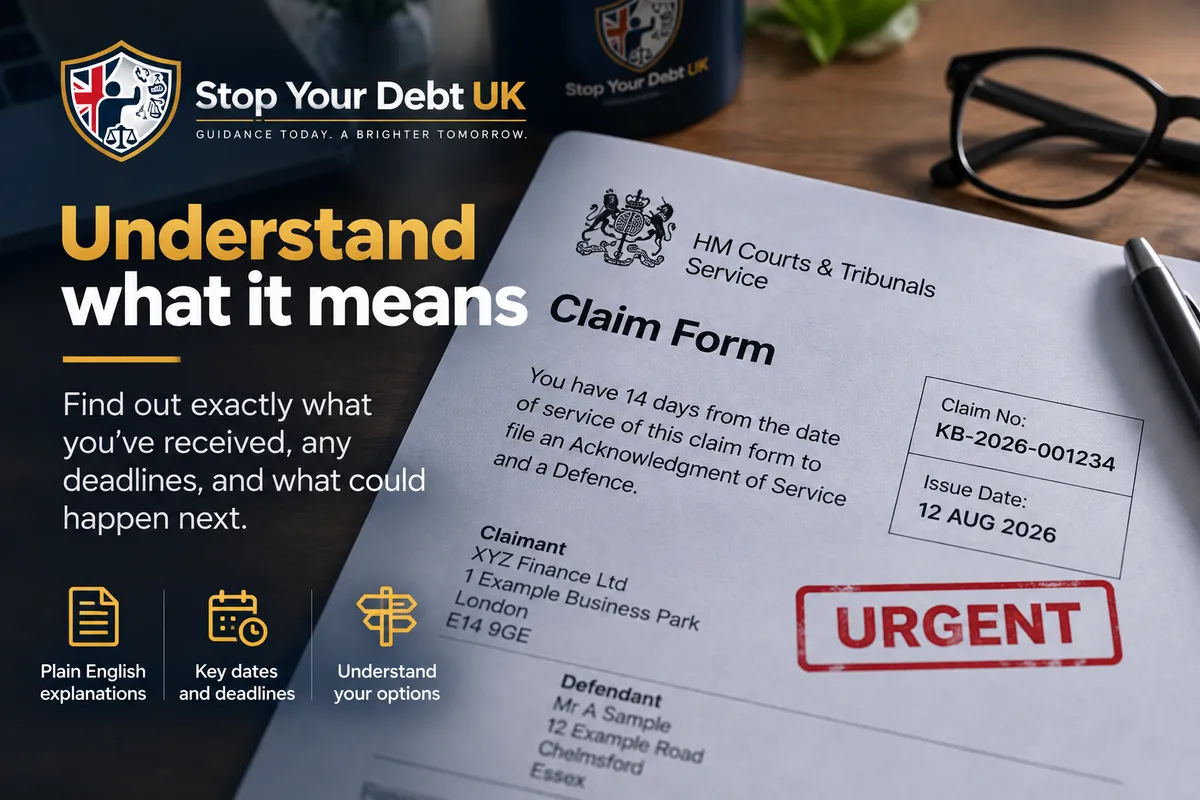
And if you have received a concerning creditor, HMRC, solicitor or debt collection letter, you can also upload it through LetterChekr™ to receive a plain-English explanation of what the letter means, what deadlines it contains and what you may need to consider next.
What Does This Letter Actually Mean?
Try LetterChekr™
Three Simple Steps
1. Upload Your Letter
Take a clear photograph of the letter or upload your document.
You don't need to understand what it says before uploading it.
2. Understand What It Means
LetterChekr™ reviews the contents and explains the important information in plain, straightforward English.
3. Understand What May Happen Next
You'll receive clear information about the urgency of the correspondence, important dates, potential consequences and the general processes that may follow.
LetterChekr™
Book a Call With a Consultant
Complete your details below and one of our consultants can discuss the letter with you and help you understand the options available.
That's it. In around 30 seconds, you'll receive a plain-English explanation of your letter.
Stop Your Debt UK is a national debt support platform helping individuals and company directors understand financial problems, organise their position and access the appropriate professional support when specialist or regulated advice is required.
Quick links
Services
Stop Your Debt UK is not an FCA-authorised debt advice firm or an SRA-regulated law firm. Where regulated or reserved professional services are required, the relevant work is undertaken by an appropriately authorised third-party professional. Learn More
© Stop Your Debt UK. 2026. All Rights Reserved.