Removal From the Register
If the full amount is paid within one month of the judgment, you can ask for the judgment to be removed from the Register of Judgments, Orders and Fines.
Information. Support. Next Steps.
Received a County Court claim, discovered a CCJ or concerned about enforcement? Stop Your Debt UK helps you understand what has happened, what stage the process has reached and what options may be available.
A County Court Judgment (CCJ) is a formal court judgment confirming that money is owed. It can be made following a claim for unpaid money and sets out what must be paid and how payment should be made.
Receiving or discovering a CCJ does not mean that every case has the same outcome. What happens next can depend on how the judgment was obtained, whether you agree that the money is owed, when the judgment was made and whether payment has already been made.
It means the court has formally decided that money is owed.
Paying a CCJ in full within one month can allow the judgment to be removed from the register.
Payment, variation, challenge and enforcement can involve different processes depending on the circumstances.
Sometimes — but the correct route depends on what has happened. Paying a judgment, having it marked as satisfied and asking the court to set a judgment aside are different processes with different consequences.
If the full amount is paid within one month of the judgment, you can ask for the judgment to be removed from the Register of Judgments, Orders and Fines.
If the judgment is paid in full after one month, it can be recorded as satisfied. It will normally remain on the register for six years, but the record will show that it has been paid.
For a default judgment, the court must set it aside where the requirements for entering default judgment were not met, including certain situations where judgment was wrongly entered.
For a default judgment, the court may set aside or vary the judgment where there is a real prospect of successfully defending the claim or another good reason. The court also considers whether the application was made promptly.
The correct route depends on the judgment, how it was obtained, whether it has been paid and whether there are proper grounds for an application to the court. A set-aside application is ultimately decided by the court.
A CCJ does not bring every case to an immediate end. The judgment sets out what is owed and how payment should be made. What happens after that depends on the payment terms, your circumstances and whether the judgment is complied with.
The judgment should explain how much is owed, the deadline for payment and whether the amount must be paid in full or by instalments. Understanding exactly what the court has ordered is the starting point.
UNDERSTAND THE ORDERIf you accept that the money is owed, consider the payment terms carefully. Keeping clear records of payments is important, particularly where payments are being made over time.
PAYMENT & RECORDSIf the existing payment terms are not affordable, it may be possible to ask the court to change the date or rate of payment. An individual can use the N245 process to provide income and expenditure information and propose an amount they can realistically afford.
PAYMENT VARIATIONIf a judgment is not paid in accordance with the order, the creditor may consider court enforcement. The appropriate method depends on the circumstances and can include processes involving enforcement agents, earnings, money held by third parties or property.
POTENTIAL ENFORCEMENTStop Your Debt UK can help you organise the correspondence, understand what stage the matter has reached and identify the appropriate next steps. Where regulated debt advice or legal advice is required, we can help connect the matter with an appropriately authorised professional.
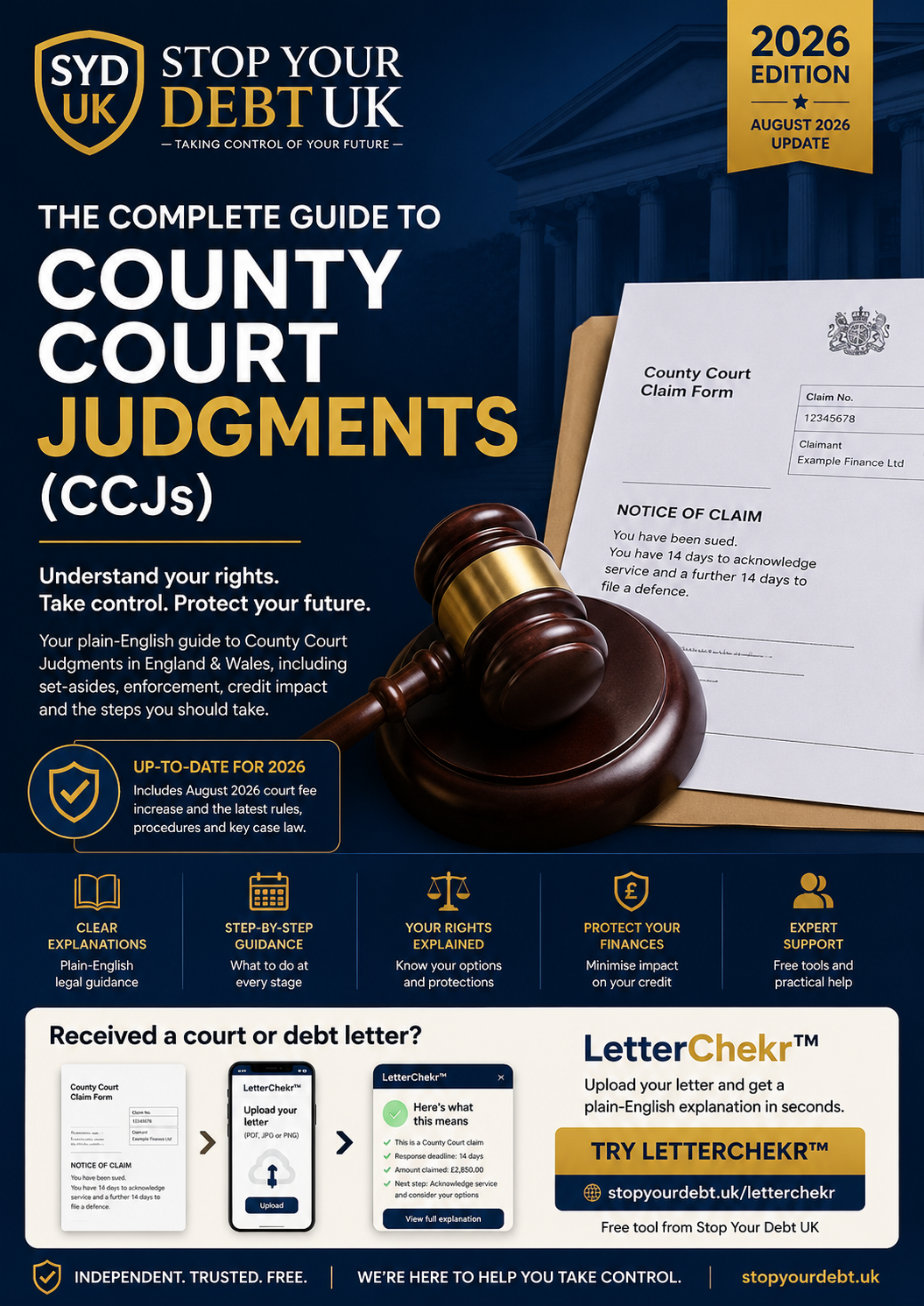
Go beyond a short internet article. Our Complete Guide to County Court Judgments explains the CCJ process from the period before court proceedings through to judgment, credit-file implications and potential enforcement.
Received a court notice, creditor letter or other debt-related correspondence? Upload the document to LetterChekr™ for a structured, plain-English explanation of what it appears to mean and the important information it contains.
Choose a PDF, JPG or PNG copy of the correspondence you have received.
The tool looks for key information including the sender, amount, reference, deadlines and the type of correspondence.
See what the correspondence appears to mean, important points to understand and general information about possible next steps.
LetterChekr™ provides an automated explanation of uploaded correspondence. It is designed to help you understand documents and is not a substitute for regulated legal or financial advice.
Complete your details below and one of our consultants can discuss the letter with you and help you understand the options available.
A County Court Judgment usually sits within a wider court process. Understanding where you are in that process can make it easier to identify deadlines, understand the documents you have received and consider what may need to happen next.
Before court proceedings, you may receive correspondence about the debt and requests for payment. The documents you receive can help show how far the matter has progressed.
If a money claim is made against you, the court correspondence will explain how and when you need to respond. Ignoring a claim can result in judgment being entered against you.
Depending on the circumstances, a defendant may pay the claim, make an offer or admission, or defend the claim. The correct response depends on what is being claimed and whether it is accepted or disputed.
A CCJ means the court has formally decided that money is owed. The judgment should state the amount, how payment must be made and the deadline or payment terms.
What happens after judgment depends on the circumstances. Payment may be made under the judgment terms, an individual may be able to ask the court to vary payment terms, or a set-aside application may be relevant where proper grounds exist.
If a judgment is not paid in accordance with its terms, the creditor may ask the court to use an available enforcement method. Enforcement is not automatically the same in every case.
A matter may be resolved before judgment, defended, paid, varied or follow another procedural route. The appropriate next step depends on the documents, dates and individual circumstances involved.
Stop Your Debt UK can help you organise the correspondence, understand the stage the matter has reached and identify appropriate next steps. Where regulated debt advice or legal advice is required, we can help connect the matter with an appropriately authorised professional.
Whether you have just received a letter, already have a County Court Judgment or simply want to understand the process, choose the route that best matches where you are now.
Upload court, creditor or debt-related correspondence and receive an automated plain-English explanation of the important information it contains.
Discuss the correspondence and circumstances with Stop Your Debt UK. We can help you organise the information, understand what stage the matter has reached and identify appropriate next steps.
Explore our free 2026 guide covering court claims, judgments, paying within one month, setting aside, enforcement, bailiffs and charging orders.
Stop Your Debt UK provides information, practical support, administration and case coordination. Stop Your Debt UK is not an FCA-authorised debt advice firm or an SRA-regulated law firm. Where regulated debt advice, legal advice, formal insolvency services or another regulated or reserved activity is required, the relevant work is undertaken by an appropriately authorised third-party professional.